
Feedback Paths
SynthEdit processes audio in blocks of samples for efficiency. This block-based architecture means that feedback loops (where a module’s output connects back to its own input) are not directly supported — the output of a block isn’t available until the block finishes processing.
The Feedback - Volts Module
Section titled “The Feedback - Volts Module”To create feedback effects (such as echo, flanging, or resonant feedback), use the Feedback - Volts module (search for “feedback” — its category is Special/Feedback; a MIDI version, Feedback - MIDI, sits alongside it for feeding MIDI backward instead). This module allows backward routing by introducing a small delay of approximately 96 samples (~2 ms at 44.1 kHz).
How It Works
Section titled “How It Works”- Place a Feedback - Volts module in the feedback path
- Route the signal from later in the chain back through Feedback - Volts to an earlier point
- The module introduces a one-block delay, allowing the feedback loop to function
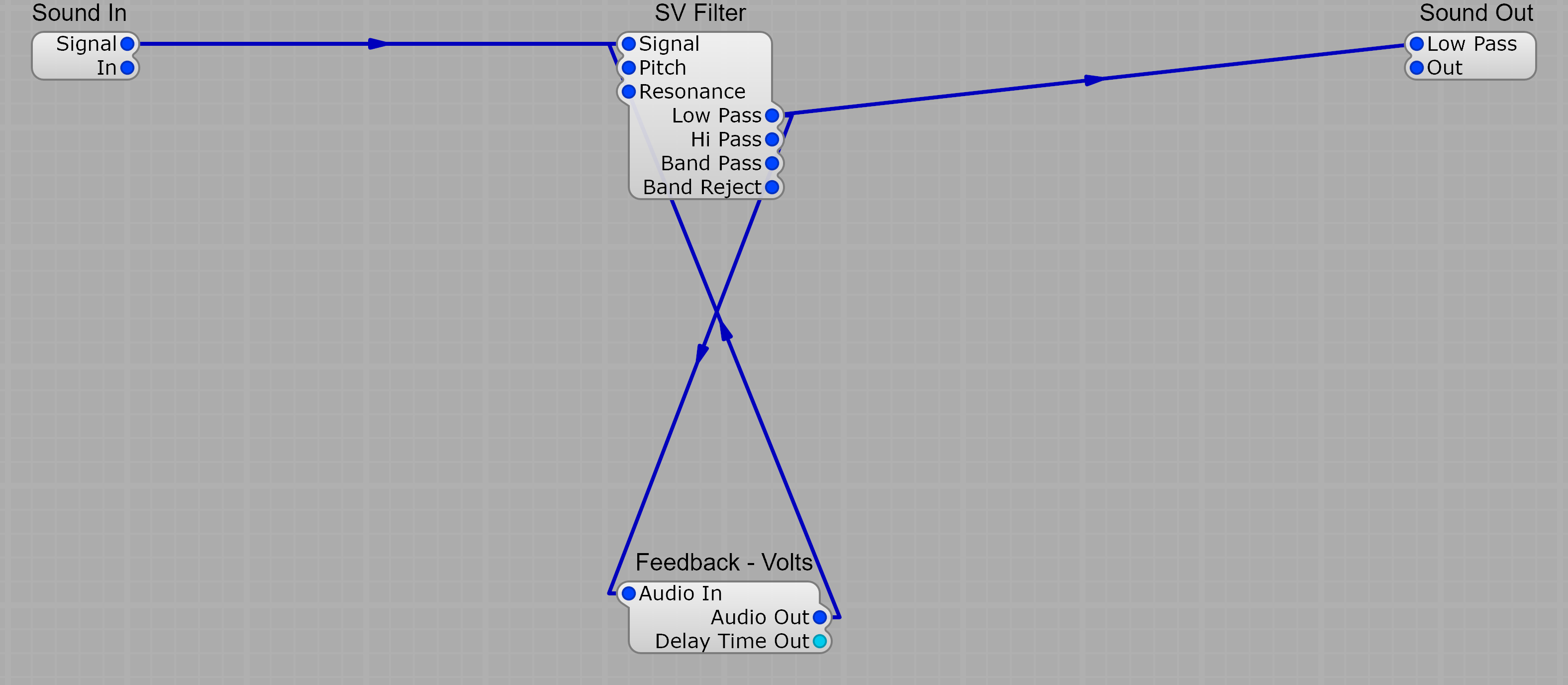
In this example the SV Filter’s output is fed back into its own input via the Feedback - Volts module, creating a resonant feedback path. Without it, SynthEdit would refuse to make the backwards connection because it can’t resolve the dependency within a single processing block.
The Feedback - Volts module also provides a Delay Time Out pin that reports the exact delay in milliseconds, which is useful for tuning delay-based effects.
Limitations
Section titled “Limitations”- The minimum feedback delay is one processing block (~96 samples)
- This delay is audible in very short feedback paths (like comb filtering)
- For longer delays (echo, reverb tails), the extra samples are negligible
- Standard delay modules handle their own internal feedback — you only need the Feedback - Volts module for external feedback paths between separate modules
When You Don’t Need Feedback - Volts
Section titled “When You Don’t Need Feedback - Volts”The Delay module has its own Feedback input that handles internal feedback without needing the Feedback - Volts module. Only use Feedback - Volts when routing signals backward between separate modules in the patch.