
ADSR2
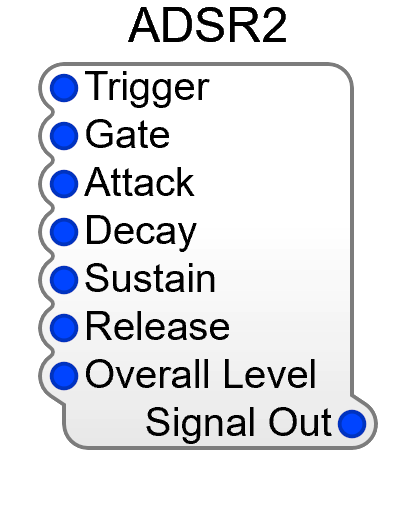
ADSR2 is the current four-stage envelope generator — Attack, Decay, Sustain, Release — and the one to reach for in new patches. It sits under Waveform in the Module Browser.
It’s the older ADSR plus a dedicated Trigger input, which is what lets an envelope restart cleanly on a repeated note instead of waiting for the gate to fall and rise again.
Inputs
Section titled “Inputs”| Pin | Type | Description |
|---|---|---|
| Trigger | Audio | Restarts the envelope from its attack stage on a rising edge, even while Gate is still high |
| Gate | Audio | Note on/off — the envelope attacks on a rising edge and releases on a falling one |
| Attack | Audio | Attack time |
| Decay | Audio | Decay time |
| Sustain | Audio | Sustain level (0–10 V) |
| Release | Audio | Release time |
| Overall Level | Audio | Scales the whole envelope output |
Outputs
Section titled “Outputs”| Pin | Type | Description |
|---|---|---|
| Signal Out | Audio | Envelope output (0–10 V) |
Wire a MIDI-CV 2’s Gate to Gate, and the envelope’s Signal Out to a VCA’s Volume. That pair — envelope into VCA — is how a note gets a beginning and an end; Your First Synth builds it step by step.
Attack, Decay and Release are times, expressed as voltages on an exponential scale: each extra volt roughly doubles the time, and negative voltages give shorter times. Sustain is a level, 0–10 V. See Signal Types & Levels.
Typical destinations for the output:
- Amplitude envelope — into a VCA’s Volume input
- Filter envelope — into a filter’s Pitch (cutoff) input
- FM envelope — into an oscillator’s Phase Mod depth, see FM Synthesis
Trigger versus Gate
Section titled “Trigger versus Gate”Drive Gate alone and a note played while the previous key is still held has no rising edge to attack on — the envelope simply carries on. Drive Trigger as well, from MIDI-CV 2’s Trigger output, and every new note restarts the envelope with no latency. That’s what makes repeated notes sound articulated rather than smeared together.