
MIDI-CV 2
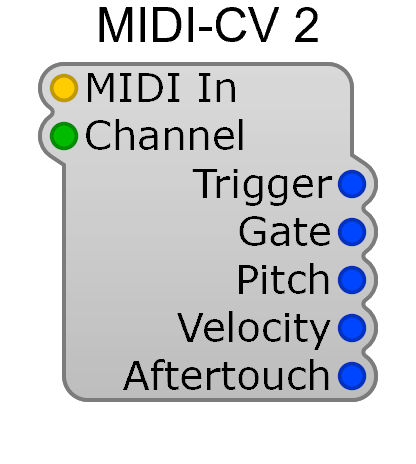
The MIDI-CV 2 module converts incoming MIDI note data into control voltages (CV) and gate signals, forming the bridge between MIDI input and the analog-style modular synthesis engine. It’s the current, recommended module for this — see MIDI to CV for the older module it replaces and how the two differ.
Place it inside the container that holds your voice modules — it’s what makes that container polyphonic (see the Polyphony guide).
Inputs
Section titled “Inputs”| Pin | Type | Description |
|---|---|---|
| MIDI In | MIDI | MIDI data input |
| Channel | Control | MIDI channel to respond to (-1 = all channels) |
Outputs
Section titled “Outputs”| Pin | Type | Description |
|---|---|---|
| Trigger | Audio | A short pulse on every new note — including a repeated note while the gate is already high. Use this for retriggering an envelope with zero latency, instead of watching the Gate signal toggle. |
| Gate | Audio | Note on/off (high while a key is held, low on release) |
| Pitch | Audio | Note pitch (1V/octave, 5V = A440) |
| Velocity | Audio | Note velocity |
| Aftertouch | Audio | Channel aftertouch |
This is an essential module for any playable synthesizer. Wire Gate to an envelope’s Gate input, Pitch to your oscillators’ Pitch inputs, and — if you want percussion-tight retriggering on repeated notes rather than relying on the Gate dropping to zero and rising again — use Trigger instead of Gate to fire the envelope.
See the Polyphony guide for details on voice management, and the FAQ for how this compares to the older MIDI to CV module.