
Phase Distortion Synthesis
Phase Distortion (PD) synthesis is a technique pioneered by Casio in the CZ-series synthesizers (CZ-1000, CZ-5000). It produces rich, filter-like timbres by distorting the phase of a waveform during playback.
How It Works
Section titled “How It Works”A standard oscillator reads through a sine wave at a constant rate. In phase distortion synthesis, the readback speed is varied within each cycle — parts of the waveform play faster, parts slower. This “distortion” of the phase reshapes the waveshape itself, producing new harmonics.
By modulating the amount of distortion, you can sweep through timbres in a way that sounds similar to a resonant filter sweep — without using an actual filter module.
The Phase Distortion Oscillator
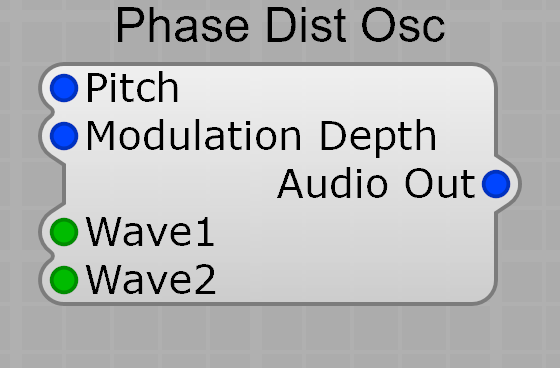
Section titled “The Phase Distortion Oscillator”SynthEdit’s Phase Dist Osc module implements this technique:
Inputs
Section titled “Inputs”| Pin | Description |
|---|---|
| Pitch | Note pitch (1V/octave, 5V = 440 Hz) |
| Modulation Depth | Amount of phase distortion (0–10V = 0–100%) |
| Wave1 | First waveform shape (Saw, Square, Pulse, Dbl Sine, Saw-Pulse, Reso1–3) |
| Wave2 | Second waveform shape (same options plus None) |
Output
Section titled “Output”| Pin | Description |
|---|---|
| Audio Out | The phase-distorted audio signal |
Creating PD Sounds
Section titled “Creating PD Sounds”Wire the oscillator into a complete patch like this:
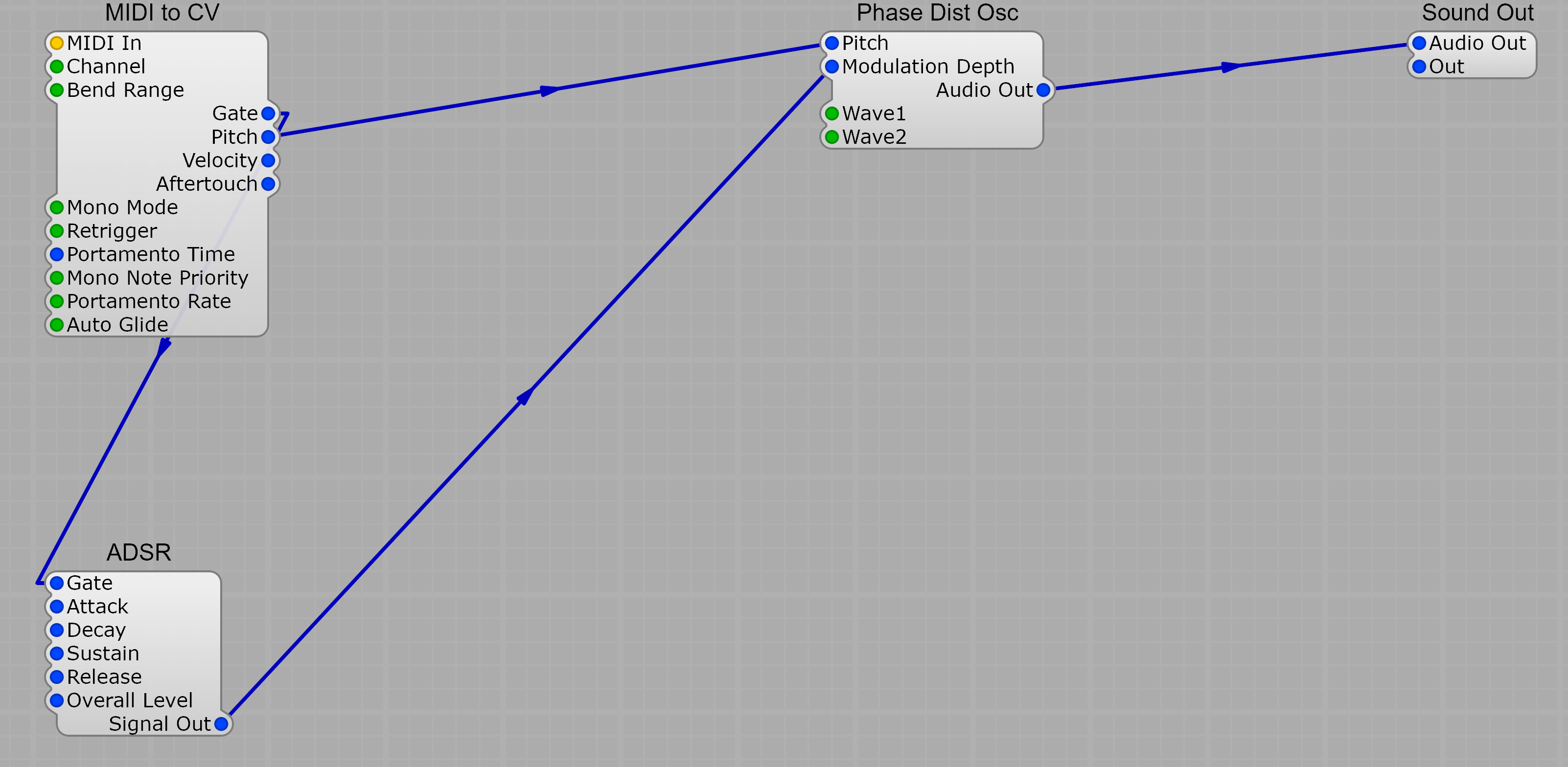
- Insert a Phase Dist Osc
- Add a MIDI to CV module — connect its Pitch output to the oscillator’s Pitch input so the patch tracks your keyboard
- Add an ADSR envelope and connect MIDI to CV’s Gate to the envelope’s Gate input — this triggers the envelope on each note
- Connect the envelope’s Signal Out to the oscillator’s Modulation Depth — this sweeps the timbre over time, much like a filter envelope
- Connect the oscillator’s Audio Out to a Sound Out module
At zero modulation, the output is a pure sine wave; at full modulation, the waveform is heavily distorted with rich harmonics.
- The Phase Distortion Oscillator is sensitive to sudden changes in modulation. If you hear clicks, filter the modulation signal to smooth out abrupt transitions.
- Velocity control works naturally here — use MIDI velocity (from MIDI to CV) to scale the envelope amount, giving harder key strikes a brighter, more distorted tone.
- PD synthesis uses less CPU than equivalent filter-based patches since no separate filter module is needed.
- Try different combinations of Wave1 and Wave2 — each pair gives a distinctly different harmonic character. The “Reso” shapes mimic resonant filter sweeps especially convincingly.